
Debugging full-stack issues
Part of the Full Stack Developer Roadmap
In short
"Users say checkout is broken. Where do you start?" Full stack bugs can hide in the browser, the network, the API or the database. Interviewers want a calm, step-by-step search.
Being able to describe how you'd track down a bug that could originate anywhere across frontend, API, or database — a skill unique to full-stack roles.
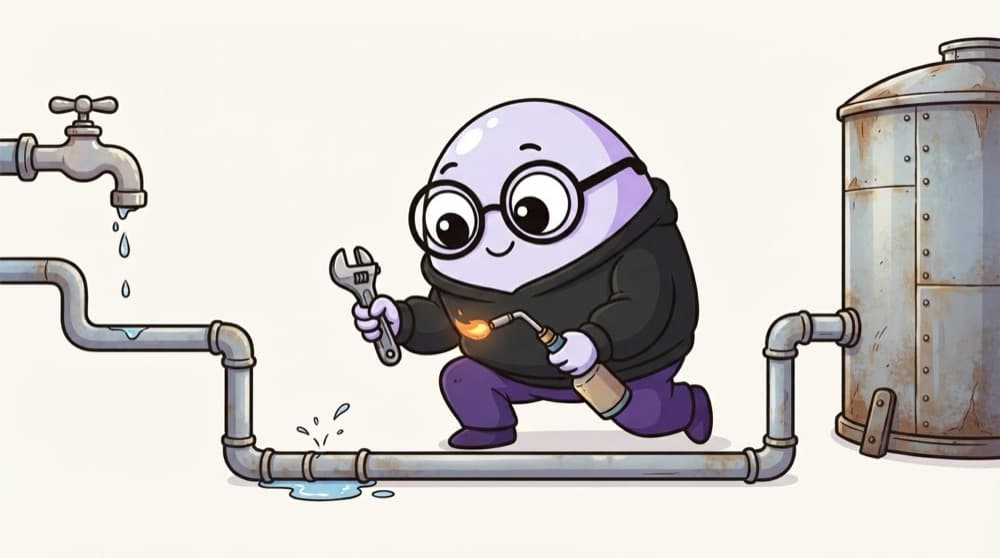
Think of it like this
Finding the leak in the pipe
No water at the tap? A good plumber doesn't rip up the floor. They check the tap, then the pipe joints, then the tank, then the main valve, each step ruling out half the problem. Debugging is the same walk, upstream.
Watch it happen
"Checkout is broken": walking the stack
1/6Get exact steps, user, time and device. Reproduce it yourself on staging before guessing.
The big ideas
What you need to know
Reproduce first
A bug you can trigger on demand is half fixed. Guessing without reproducing wastes hours.
Split the stack in half
Is the request leaving the browser? Is the server replying? Each check rules out half the places to look.
Request ids connect layers
One id in the response header and every log line lets you follow a single request end to end.
Fix the class of bug
After the fix, add a test or a constraint so the same kind of bug can't come back quietly.
See it in code
Walk through the code
1import { randomUUID } from "node:crypto";2 3// Give every request an id, log it, and send it back to the browser4app.use((req, res, next) => {5 const id = req.get("x-request-id") ?? randomUUID();6 res.set("x-request-id", id);7 const start = Date.now();8 res.on("finish", () => {9 console.log(JSON.stringify({10 id, method: req.method, path: req.originalUrl,11 status: res.statusCode, ms: Date.now() - start, userId: req.user?.id,12 }));13 });14 next();15});16// "Checkout failed"? Copy x-request-id from DevTools and search the logs for it.1/3Reuse an id from a proxy if one exists, otherwise create one, and return it in the response headers.
A tiny Express middleware that makes full stack debugging far easier: every response carries an id you can find in the server logs.
Save yourself the pain
Common mistakes
Oops
Changing code at random until the error goes away.
Do this instead
Form one hypothesis, test it, and narrow down layer by layer. Say this process out loud in the interview.
Oops
Stopping once the symptom is gone.
Do this instead
Find the root cause, add a test that would have caught it, and mention monitoring.
Your mission
Plant a bug, then find it
Quick check
The Network tab shows the checkout request was never sent. Where should you look first?
Go deeper
- 1Prepare a real story of a bug where it wasn't initially clear which layer was at fault.
- 2Practice a structured approach: check the network request/response first, then narrow down.
- 3Learn to use browser DevTools and backend logs together to triangulate an issue.
More technical at this stop
 Frontend fundamentals
 Backend fundamentals
 Database design
 System design (full-stack)
 API design
 Authentication & security
 Performance across the stack

Stuck on this topic? Ask an Insider
Get 1:1 guidance from people who've walked this exact path — on the InsideEdge app.
