In short
Undo buttons, browser back history, bracket checkers, print queues and BFS all rest on two tiny ideas: last in first out, and first in first out.
Stacks (last-in, first-out) and queues (first-in, first-out) solve problems like bracket matching, undo features and level-by-level processing. ArrayDeque implements both in Java.
Think of it like this
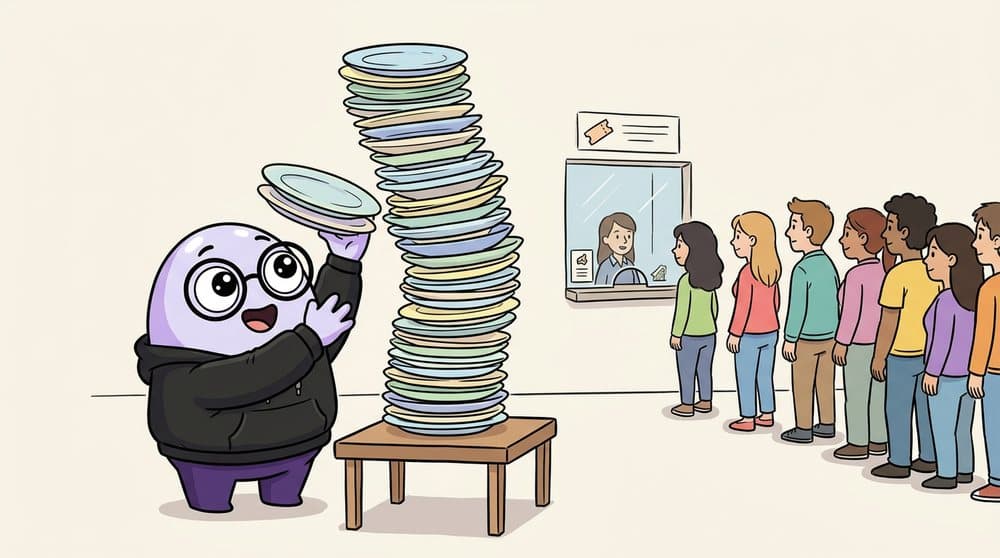
Plates and the ticket line
At a wedding buffet, you take the top plate from the stack, the last one the staff put down. Outside at the cinema, the ticket line serves whoever came first. A stack is the plate pile. A queue is the ticket line.
Watch it happen
Checking {[()]} with a stack
Top of the stack is coloured
1/6An opening bracket: push it.
The big ideas
What you need to know
Stack: LIFO
push adds to the top, pop removes from the top, peek looks without removing. All O(1).
Queue: FIFO
offer adds at the back, poll removes from the front, peek looks at the front. All O(1).
Use ArrayDeque
Deque<T> stack = new ArrayDeque<>() and Queue<T> q = new ArrayDeque<>(). The old Stack class is legacy and slower.
Spot the pattern
Matching pairs, undo or 'most recent' means stack. Processing in arrival order or level by level means queue.
See it in code
Walk through the code
1import java.util.ArrayDeque;2import java.util.Deque;3import java.util.Map;4import java.util.Queue;5 6public class StackQueueDemo {7 static boolean isBalanced(String s) {8 Map<Character, Character> pairs = Map.of(')', '(', ']', '[', '}', '{');9 Deque<Character> stack = new ArrayDeque<>();10 for (char c : s.toCharArray()) {11 if (c == '(' || c == '[' || c == '{') {12 stack.push(c);13 } else if (pairs.containsKey(c)) {14 char open = pairs.get(c);15 if (stack.isEmpty() || stack.pop() != open) return false;16 }17 }18 return stack.isEmpty();19 }20 21 public static void main(String[] args) {22 System.out.println(isBalanced("{[()]}")); // true23 System.out.println(isBalanced("([)]")); // false24 25 Queue<String> ticketLine = new ArrayDeque<>();26 ticketLine.offer("Asha");27 ticketLine.offer("Vikram");28 System.out.println(ticketLine.poll()); // Asha29 }30}1/5A map from each closing bracket to its opener, and an ArrayDeque used as a stack.
A bracket checker with a stack, and a first-come-first-served line with a queue. Both use ArrayDeque.
Save yourself the pain
Common mistakes
Oops
Using java.util.Stack.
Do this instead
Stack extends the old synchronized Vector. ArrayDeque is the recommended replacement.
Oops
Comparing two Character objects with == or !=.
Do this instead
That compares references. Unbox to char, as above, or use equals().
Oops
Calling pop() on an empty ArrayDeque.
Do this instead
It throws NoSuchElementException. Check isEmpty() first, or use poll(), which returns null.
Your mission
Stack and queue set
Quick check
Your browser's back button should return to the page you visited most recently. Which structure fits?
Go deeper
- 1Solve 'valid parentheses' using ArrayDeque as a stack.
- 2Implement a queue using two stacks.
- 3Solve a 'next greater element' problem with a monotonic stack.
More topics at this stop
 Big-O Notation
 Array & String Problems
 Two Pointers & Sliding Window
 Recursion & Backtracking
 Sorting & Binary Search
 Linked Lists
 Trees & Binary Search Trees
 Heaps
 Graphs (BFS & DFS)
 Dynamic Programming Basics

Stuck on this topic? Ask an Insider
Get 1:1 guidance from people who've walked this exact path — on the InsideEdge app.
