
Recursion & Backtracking
Part of the Java Roadmap
In short
Trees, permutations, mazes and many DP problems are much easier to express when a method can call itself. Backtracking adds one more habit: try a choice, and undo it if it leads nowhere.
Recursion solves a problem by calling itself on smaller inputs until a base case. Backtracking builds solutions step by step and undoes choices that fail, as in permutations or N-Queens.
Think of it like this
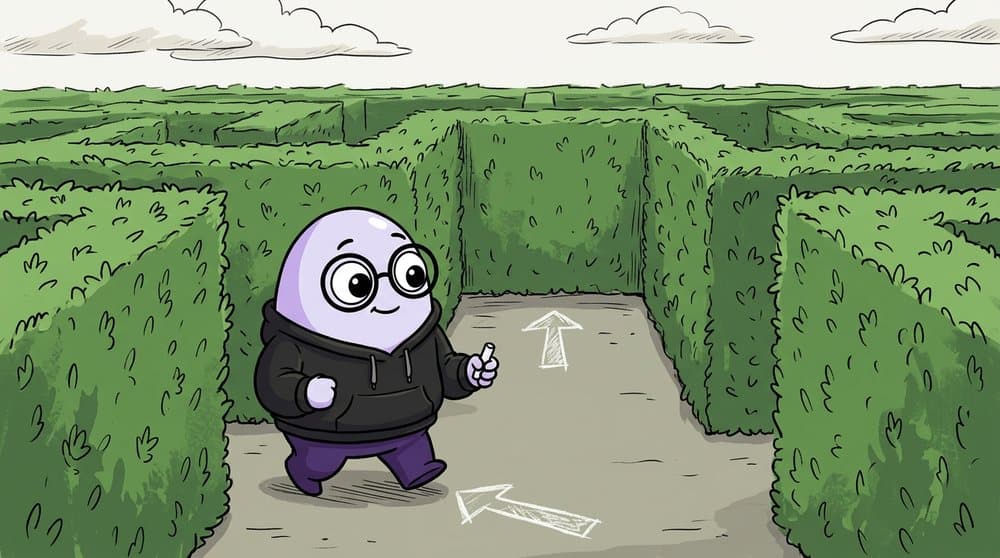
Exploring a maze with chalk
Lost in a hedge maze at a fair, you mark each turning with chalk. At a dead end you walk back to the last mark and try the next path. You never wander the same dead end twice. Choose, explore, and un-choose is exactly what backtracking code does.
Watch it happen
Building permutations of 1, 2, 3
1/5Start with an empty path and three unused numbers.
The big ideas
What you need to know
Base case first
Every recursive method needs a condition that stops it. Without one you get StackOverflowError.
Smaller each time
Each call must move towards the base case: n - 1, a shorter string, a smaller subtree.
Choose, explore, un-choose
Add a choice, recurse, then remove it. That undo step is what makes it backtracking.
The call stack
Every call takes stack memory. Recursion depth of n means O(n) space, even with no extra arrays.
See it in code
Walk through the code
1import java.util.ArrayList;2import java.util.List;3 4public class Backtracking {5 static long factorial(int n) {6 if (n <= 1) return 1; // base case7 return n * factorial(n - 1); // smaller problem8 }9 10 static void permute(List<Integer> nums, List<Integer> path,11 boolean[] used, List<List<Integer>> result) {12 if (path.size() == nums.size()) {13 result.add(new ArrayList<>(path)); // save a copy14 return;15 }16 for (int i = 0; i < nums.size(); i++) {17 if (used[i]) continue;18 used[i] = true;19 path.add(nums.get(i)); // choose20 permute(nums, path, used, result); // explore21 path.remove(path.size() - 1); // un-choose22 used[i] = false;23 }24 }25 26 public static void main(String[] args) {27 List<List<Integer>> result = new ArrayList<>();28 permute(List.of(1, 2, 3), new ArrayList<>(), new boolean[3], result);29 System.out.println(result); // [[1, 2, 3], [1, 3, 2], [2, 1, 3], ...]30 System.out.println(factorial(5)); // 12031 }32}1/4Classic recursion: a base case, then the same problem on n - 1.
Plain recursion with factorial, and backtracking that builds all six permutations of three numbers.
Save yourself the pain
Common mistakes
Oops
result.add(path) without copying.
Do this instead
path keeps changing, so every saved entry ends up empty. Save new ArrayList<>(path).
Oops
path.remove(Integer.valueOf(x)) vs path.remove(i) mix-ups.
Do this instead
On a List<Integer>, remove(int) removes by index and remove(Object) by value. Removing the last index is the safe undo.
Oops
Recursing a million levels deep on a linked list.
Do this instead
Java's default stack handles a few thousand frames comfortably. Use a loop for very deep inputs.
Your mission
Recursion ladder
Quick check
What happens if a recursive method has no reachable base case?
Go deeper
- 1Write factorial, power and Fibonacci recursively, then trace the call stack.
- 2Generate all subsets and permutations of a small array.
- 3Learn what causes a StackOverflowError.
Also part of these roadmaps
More topics at this stop
 Big-O Notation
 Array & String Problems
 Two Pointers & Sliding Window
 Sorting & Binary Search
 Linked Lists
 Stacks & Queues
 Trees & Binary Search Trees
 Heaps
 Graphs (BFS & DFS)
 Dynamic Programming Basics

Stuck on this topic? Ask an Insider
Get 1:1 guidance from people who've walked this exact path — on the InsideEdge app.
