
Trees & Binary Search Trees
Part of the Java Roadmap
In short
Folders on your laptop, the HTML of a web page and Java's own TreeMap are all trees. Binary search trees add one rule that makes searching as quick as flipping through a sorted list.
Trees are hierarchical structures. In a binary search tree, left children are smaller and right children are larger, giving O(log n) operations when the tree is balanced.
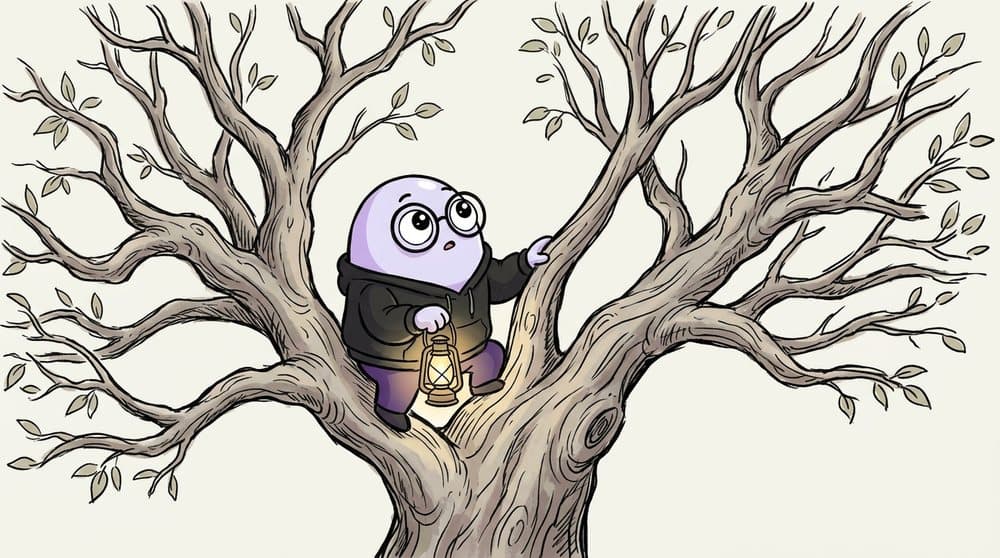
Think of it like this
The family tree with a rule
Picture a family tree where every younger sibling's line goes to the left and every older one to the right. To find someone born in 1995, you start at the eldest ancestor and keep asking 'before or after?'. Each answer rules out a whole branch of the family.
Watch it happen
Searching a BST for 60
1/4Start at the root, 50. 60 is bigger, so go right.
The big ideas
What you need to know
Tree words
Root, parent, child, leaf, height and depth. A binary tree has at most two children per node.
The BST rule
Everything in the left subtree is smaller and everything in the right subtree is larger, at every node.
Traversals
Pre-order (node first), in-order (sorted for a BST), post-order (children first) and level-order with a queue.
Balance matters
Balanced, it is O(log n). Insert sorted data into a plain BST and it becomes a slow O(n) line. TreeMap uses a self-balancing red-black tree.
See it in code
Walk through the code
1public class BST {2 static class Node {3 int val;4 Node left, right;5 Node(int val) { this.val = val; }6 }7 8 static Node insert(Node root, int val) {9 if (root == null) return new Node(val);10 if (val < root.val) root.left = insert(root.left, val);11 else if (val > root.val) root.right = insert(root.right, val);12 return root;13 }14 15 static boolean contains(Node root, int val) {16 while (root != null) {17 if (val == root.val) return true;18 root = val < root.val ? root.left : root.right;19 }20 return false;21 }22 23 static void inorder(Node root) {24 if (root == null) return;25 inorder(root.left);26 System.out.print(root.val + " ");27 inorder(root.right);28 }29 30 static int height(Node root) {31 if (root == null) return 0;32 return 1 + Math.max(height(root.left), height(root.right));33 }34 35 public static void main(String[] args) {36 Node root = null;37 for (int v : new int[] {50, 30, 70, 20, 40, 60, 80}) root = insert(root, v);38 System.out.println(contains(root, 60)); // true39 inorder(root); // 20 30 40 50 60 70 8040 }41}1/4Recursive insert: walk left or right until an empty spot, then attach a new node there.
Insert, search, in-order traversal and height on a small BST.
Save yourself the pain
Common mistakes
Oops
Only checking node.left.val < node.val < node.right.val to validate a BST.
Do this instead
The rule applies to whole subtrees. Pass down a min and max range as you recurse.
Oops
Forgetting the null base case in tree recursion.
Do this instead
Start almost every tree method with if (root == null) return ...;
Your mission
Tree workout
Quick check
Which traversal prints the values of a BST in ascending order?
Go deeper
- 1Implement inorder, preorder, postorder and level-order traversal.
- 2Insert and search in a BST you build yourself.
- 3Solve 'maximum depth' and 'validate BST' problems.
More topics at this stop
 Big-O Notation
 Array & String Problems
 Two Pointers & Sliding Window
 Recursion & Backtracking
 Sorting & Binary Search
 Linked Lists
 Stacks & Queues
 Heaps
 Graphs (BFS & DFS)
 Dynamic Programming Basics

Stuck on this topic? Ask an Insider
Get 1:1 guidance from people who've walked this exact path — on the InsideEdge app.
