In short
A box around a tumour or a road is too rough when you need the exact shape. Segmentation labels every single pixel, so you know precisely where one thing ends and another begins.
Classifying every pixel in an image (semantic) or every pixel per object instance (instance segmentation) — finer-grained than detection, used in medical imaging and autonomous driving.
Think of it like this
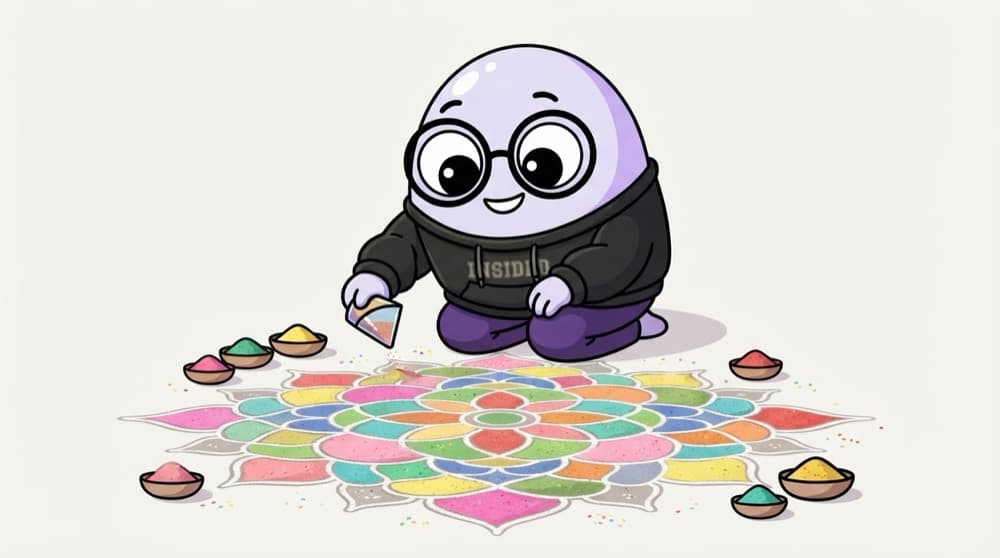
Filling in the rangoli
Drawing a rangoli outline is easy. Filling it is the real work: every little region gets its own colour and no gap is left blank. Segmentation fills the image the same way, giving every pixel a class like road, sky or person.
Watch it happen
Two kinds of segmentation
Semantic
- One class per pixel
- All people share one colour
- Good for roads, sky, land
Instance
- Each object gets its own mask
- Person 1 and person 2 differ
- Good for counting things
Use semantic when you care about 'what kind of stuff is here'. Use instance when you need to separate and count individual objects.
The big ideas
What you need to know
Output is a mask
The model returns an array the same size as the image, with a class number in every pixel.
Encoder-decoder shape
U-Net style models shrink the image to understand it, then grow it back to full size to label each pixel.
Panoptic does both
Panoptic segmentation combines semantic labels for background stuff with instance masks for countable objects.
Measure with IoU
Compare predicted and true masks with IoU or Dice. Pixel accuracy misleads when background covers most of the image.
See it in code
Walk through the code
1import torch2from torchvision.models.segmentation import deeplabv3_resnet50, DeepLabV3_ResNet50_Weights3from PIL import Image4 5weights = DeepLabV3_ResNet50_Weights.DEFAULT6model = deeplabv3_resnet50(weights=weights).eval()7prep = weights.transforms()8 9img = Image.open("street.jpg").convert("RGB")10with torch.no_grad():11 out = model(prep(img).unsqueeze(0))["out"] # (1, classes, H, W)12 13mask = out.argmax(1)[0] # (H, W) class id per pixel14print(mask.shape, mask.unique())1/3Load pretrained weights and the matching preprocessing, so input is handled correctly.
A pretrained DeepLabV3 gives a class for every pixel. argmax picks the most likely class at each spot.
Save yourself the pain
Common mistakes
Oops
Using plain pixel accuracy when 90 percent of the image is background.
Do this instead
A model predicting 'background' everywhere scores 90 percent. Use per-class IoU or Dice instead.
Oops
Using segmentation when boxes would do.
Do this instead
Pixel labels are slow and costly to annotate. If you only need to count or locate, detection is cheaper.
Your mission
Colour a street scene
Quick check
A photo has three people standing together. Semantic segmentation would:
Go deeper
- 1Run a pretrained segmentation model and visualize the pixel-level mask output.
- 2Learn the difference between semantic and instance segmentation.
- 3Understand common use cases where segmentation is required over detection.
More topics at this stop
 Image Preprocessing
 OpenCV Basics
 CNN Architectures (ResNet, VGG, EfficientNet)
 Object Detection (YOLO, Overview)
 Vision Transformers (ViT)
 Transfer Learning for Vision
 Image Augmentation
 OCR Basics

Stuck on this topic? Ask an Insider
Get 1:1 guidance from people who've walked this exact path — on the InsideEdge app.
