In short
Transformers took over text, and then someone asked: what if an image were just a sentence of little squares? That idea, ViT, now rivals or beats CNNs on many vision tasks.
Applying the Transformer architecture to images by splitting them into patches treated like tokens — now competitive with or better than CNNs on many vision benchmarks.
Think of it like this
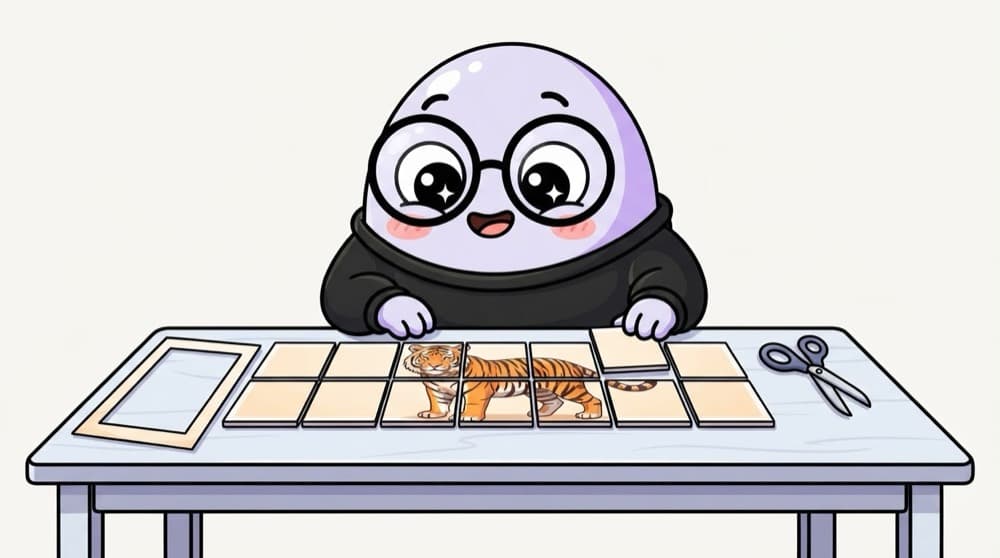
A photo cut into cards
Cut a tiger photo into nine square cards and lay them in a row. Each card alone is just stripes or an eye. But if every card can look at every other card, together they clearly say 'tiger'. ViT treats each patch like a word in a sentence.
Watch it happen
From pixels to a class with ViT
1/5A 224x224 image goes in.
The big ideas
What you need to know
Patches are tokens
ViT doesn't use convolutions to scan the image. It cuts it into patches and treats them like words.
Global view from layer one
Attention links far-apart patches immediately. CNNs only see far areas after many layers stack up.
Data hungry
With little data, ViTs tend to lag CNNs. Pretrained on huge datasets, they transfer very well.
Position must be added
Attention has no sense of order, so position embeddings tell the model where each patch sits.
See it in code
Walk through the code
1from transformers import pipeline2 3clf = pipeline("image-classification",4 model="google/vit-base-patch16-224")5 6for pred in clf("tiger.jpg", top_k=3):7 print(pred["label"], round(pred["score"], 3))8 9# Patch maths for this model:10# 224 / 16 = 14 patches per side -> 196 patches + 1 [CLS] token1/3The model name tells you the patch size (16) and the input size (224).
A ViT-Base model with 16x16 patches, pretrained on ImageNet-21k and fine-tuned on ImageNet-1k.
Save yourself the pain
Common mistakes
Oops
Training a ViT from scratch on 2,000 images.
Do this instead
Start from a pretrained ViT and fine-tune. From scratch, a small CNN will likely do better on small data.
Oops
Assuming a bigger input image costs the same.
Do this instead
Doubling width and height gives four times the patches, and attention cost grows with the square of token count.
Your mission
ViT vs ResNet on your photos
Quick check
A ViT uses 16x16 patches on a 224x224 image. How many patch tokens does it create?
Go deeper
- 1Read how ViT splits an image into patches and embeds them like sequence tokens.
- 2Fine-tune a pretrained ViT on a small image classification dataset.
- 3Compare ViT and CNN performance/data requirements at a conceptual level.
More topics at this stop
 Image Preprocessing
 OpenCV Basics
 CNN Architectures (ResNet, VGG, EfficientNet)
 Object Detection (YOLO, Overview)
 Image Segmentation (Overview)
 Transfer Learning for Vision
 Image Augmentation
 OCR Basics

Stuck on this topic? Ask an Insider
Get 1:1 guidance from people who've walked this exact path — on the InsideEdge app.
