
In short
Translation, chat replies and summaries all turn one sequence of words into another. Sequence models handle input and output of any length, and set the stage for transformers.
Applying RNNs/LSTMs (from Phase 9) specifically to text — processing a sequence of word embeddings to capture context and order, the pre-Transformer standard for tasks like sentiment analysis.
Think of it like this
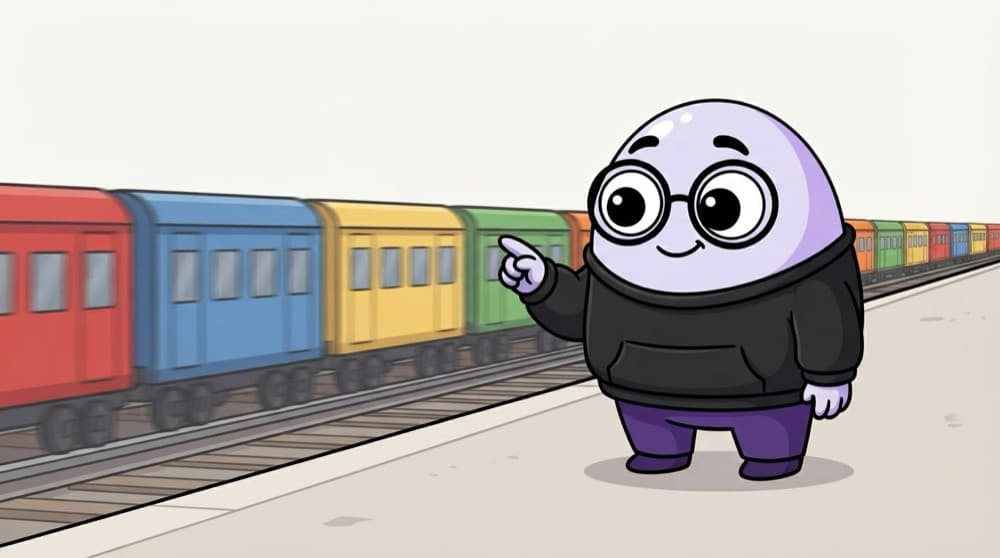
Watching the train go by
On the platform you watch carriages pass one by one, in order. By the end, you have a picture of the whole train in your head. An encoder reads words the same way and builds a summary. A decoder then writes the output, one word at a time.
Watch it happen
Encoder-decoder translating 'chai is hot'
'chai'
1/6The encoder reads the first word and updates its hidden state.
The big ideas
What you need to know
Seq2seq
An encoder reads the input, a decoder generates the output. Lengths can differ, which is what translation needs.
The bottleneck
Squeezing a long sentence into one vector loses detail. Attention was invented to fix exactly this.
Bidirectional reading
For classification, reading left-to-right and right-to-left gives each word context from both sides.
Padding and masks
Batches need equal lengths, so short sentences are padded. Masks tell the model to ignore the padding.
See it in code
Walk through the code
1import keras2from keras import layers3 4vectorize = layers.TextVectorization(max_tokens=10000, output_sequence_length=50)5vectorize.adapt(["the food was not good", "loved the service"]) # use your full corpus6 7model = keras.Sequential([8 keras.Input(shape=(1,), dtype="string"),9 vectorize,10 layers.Embedding(10000, 64),11 layers.Bidirectional(layers.LSTM(32)),12 layers.Dense(1, activation="sigmoid"),13])14model.compile(optimizer="adam", loss="binary_crossentropy", metrics=["accuracy"])1/4Build a vocabulary and turn each text into 50 token IDs, padded or cut.
A sequence classifier: raw strings in, a positive or negative probability out. Adapt the vectorizer on your real training text.
Save yourself the pain
Common mistakes
Oops
Setting the sequence length to the longest text in the dataset.
Do this instead
Check the length distribution and pick something like the 95th percentile to save memory.
Oops
Building a seq2seq model from scratch for a real translation product.
Do this instead
Learn the idea here, then use a pretrained transformer for real-world translation or summarisation.
Your mission
Train on IMDB reviews
Quick check
In a basic encoder-decoder, what does the decoder receive from the encoder?
Go deeper
- 1Build a simple LSTM-based text classifier on a small labeled dataset.
- 2Compare its performance to a simpler Bag of Words / TF-IDF baseline model.
- 3Learn why sequence order matters for meaning in ways Bag of Words completely ignores.
More topics at this stop
 Text Preprocessing (Tokenization, Stemming, Lemmatization)
 Bag of Words & TF-IDF
 Word Embeddings (Word2Vec, GloVe)
 Transformers & Attention (Overview)
 Pretrained LLMs & Fine-Tuning Basics
 Prompt Engineering for Data Tasks

Stuck on this topic? Ask an Insider
Get 1:1 guidance from people who've walked this exact path — on the InsideEdge app.
