Knowledge Graphs (Overview)
Part of the AI Engineer Roadmap
In short
Some questions are about connections: 'Which suppliers of our top product are in Gujarat?' Plain chunk search struggles with that. Knowledge graphs store facts as linked entities, so you can follow the links.
Structured representations of entities and their relationships — an alternative or complement to vector search for queries that need explicit relational reasoning.
Think of it like this
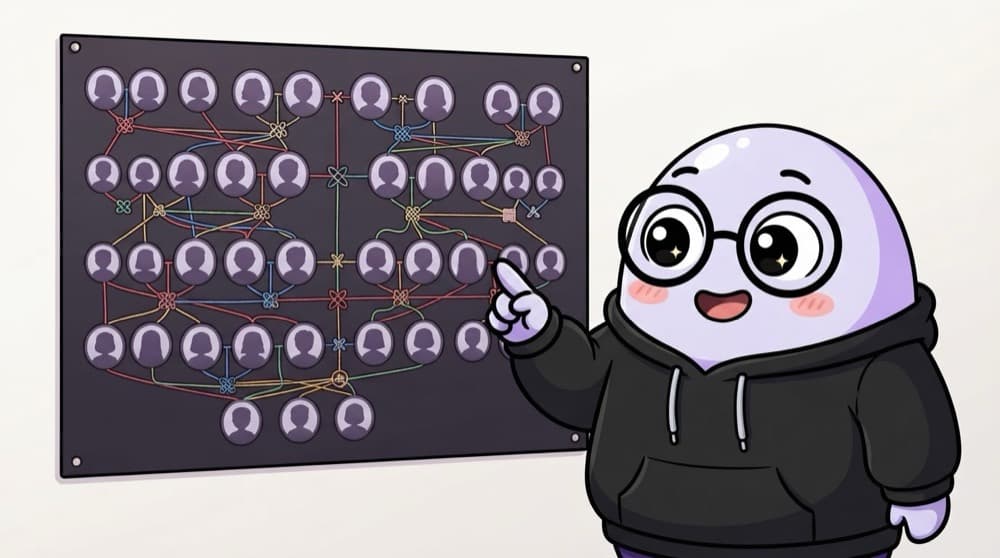
The wedding family tree
At a big Indian wedding, someone always draws the family tree: who is whose cousin, whose mama, whose daughter-in-law. With the tree, 'how is Rohan related to Priya?' is a quick walk along the lines. A knowledge graph is that tree, for any kind of fact.
Watch it happen
Facts around one company (fictional)
1/5Each node is an entity. Each line is a relationship, stored as a triple: (Zentro, HQ_IN, Pune).
The big ideas
What you need to know
Triples are the unit
Facts are stored as (subject, relation, object), like (Asha, CEO_OF, Zentro).
Great for multi-hop
Questions that chain relationships are easy on a graph and hard with chunk similarity alone.
LLMs can build them
An LLM can extract entities and relations from text into triples. Check quality, since it makes mistakes.
Graph databases
Neo4j is a popular graph database, queried with a language called Cypher.
See it in code
Walk through the code
1// Cypher (Neo4j): create a few facts2CREATE (z:Company {name: "Zentro"})-[:MAKES]->(p:Product {name: "KoolFan"}),3 (p)-[:SUPPLIED_BY]->(s:Company {name: "MotoCo", state: "Gujarat"})4 5// Multi-hop question: suppliers of Zentro's products in Gujarat6MATCH (:Company {name: "Zentro"})-[:MAKES]->(:Product)-[:SUPPLIED_BY]->(s:Company)7WHERE s.state = "Gujarat"8RETURN s.name1/3Create nodes with labels and properties, linked by named relationships.
Cypher describes paths with arrows. The query walks Company to Product to Supplier in one pattern.
Save yourself the pain
Common mistakes
Oops
Building a knowledge graph for simple document Q&A.
Do this instead
Plain RAG is enough for most 'what does the document say' questions. Use graphs when relationships are the point.
Oops
Trusting LLM-extracted triples without checks.
Do this instead
Sample and review extracted facts. Merge duplicate entities like 'Zentro' and 'Zentro Ltd'.
Your mission
Map your college
Quick check
Which question benefits most from a knowledge graph over plain chunk retrieval?
Go deeper
- 1Read how GraphRAG combines knowledge graphs with vector retrieval.
- 2Understand when relational queries (multi-hop reasoning) beat plain vector similarity.
- 3Explore a simple knowledge graph tool at an overview level, without building a production one.
More topics at this stop
 Embeddings & Semantic Search
 Vector Databases (Pinecone, Chroma, Weaviate, FAISS)
 Chunking Strategies
 RAG Architecture
 Hybrid Search (Keyword + Vector)
 Reranking
 Context Window Management
 Evaluating RAG Pipelines

Stuck on this topic? Ask an Insider
Get 1:1 guidance from people who've walked this exact path — on the InsideEdge app.
