
RAG Architecture
Part of the AI Engineer Roadmap
In short
LLMs don't know your college's rules or yesterday's news. RAG fetches the right passages first and hands them to the model with the question. It's the most common way to build useful AI assistants.
Retrieval-Augmented Generation — retrieving relevant context from a knowledge base and injecting it into a prompt so the model answers grounded in real data instead of memory alone.
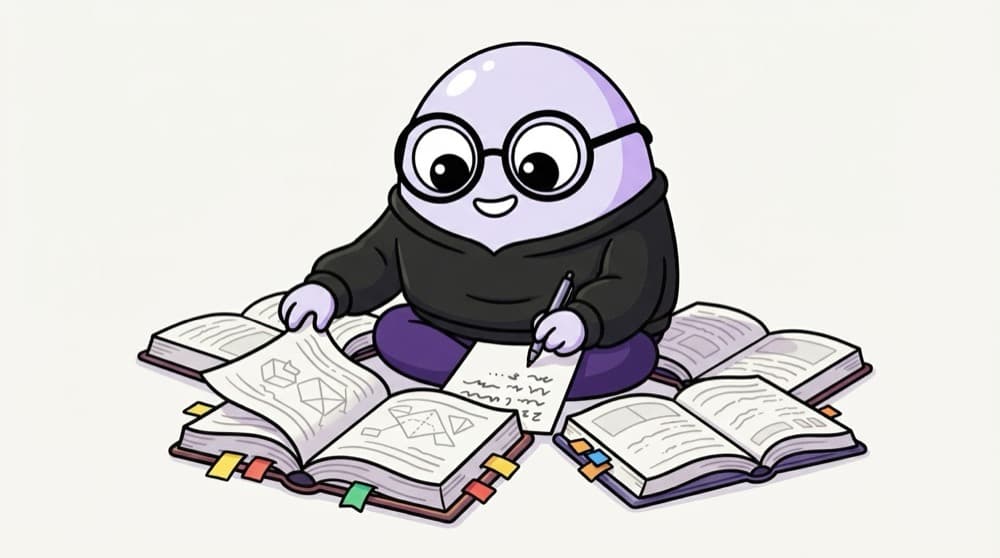
Think of it like this
The open-book exam
In an open-book exam, you don't memorise everything. You find the right pages using bookmarks, read them, then write your answer in your own words. RAG is the model taking an open-book exam: Retrieve the pages, then Generate the answer.
Watch it happen
One question through a RAG app
Min attendance?
1/6A student asks: 'What's the minimum attendance to sit for exams?'
The big ideas
What you need to know
Indexing happens first
Offline: load documents, chunk, embed and store. Online: embed the question, retrieve, then generate.
Fresh knowledge, no retraining
Update the documents and re-index. The model's answers change without any fine-tuning.
Citations build trust
Return sources with each answer so users can check, and so you can debug wrong ones.
Retrieval is the weak link
If the right chunk isn't retrieved, the best LLM can't answer. Most RAG fixes are retrieval fixes.
See it in code
Walk through the code
1import chromadb2 3docs = chromadb.PersistentClient(path="./db").get_collection("rulebook")4 5def answer(question: str) -> str:6 hits = docs.query(query_texts=[question], n_results=4)7 context = "\n\n".join(8 f"[p.{m['page']}] {d}" for d, m in zip(hits["documents"][0], hits["metadatas"][0])9 )10 prompt = (f"Answer using only the context. Cite pages like [p.12]. "11 f"If the answer isn't there, say so.\n\n<context>\n{context}\n</context>\n\n"12 f"Question: {question}")13 return ask_llm(prompt)1/4Open the collection you indexed earlier, with page numbers as metadata.
The online half of RAG in a dozen lines: retrieve, build a grounded prompt, generate. ask_llm is your helper.
Save yourself the pain
Common mistakes
Oops
Blaming the LLM when answers are wrong.
Do this instead
First print the retrieved chunks. Often the right passage was never retrieved.
Oops
Stuffing 30 chunks into the prompt 'just in case'.
Do this instead
More context adds noise and cost. Retrieve fewer, better chunks, and rerank if needed.
Your mission
RAG over one PDF
Quick check
A RAG bot gives a wrong answer. What should you check first?
Go deeper
- 1Build the full RAG loop end-to-end: embed, store, retrieve, inject into prompt, generate.
- 2Learn where each failure mode (bad retrieval, bad chunking, weak prompt) shows up in outputs.
- 3Compare RAG output quality against the same model with no retrieved context.
More topics at this stop
 Embeddings & Semantic Search
 Vector Databases (Pinecone, Chroma, Weaviate, FAISS)
 Chunking Strategies
 Hybrid Search (Keyword + Vector)
 Reranking
 Context Window Management
 Evaluating RAG Pipelines
 Knowledge Graphs (Overview)

Stuck on this topic? Ask an Insider
Get 1:1 guidance from people who've walked this exact path — on the InsideEdge app.
