
Debugging Model Performance Issues
Part of the AI Engineer Roadmap
In short
"Your model's accuracy dropped. What do you do?" Interviewers want a calm, ordered process, not a list of random tricks. Data first, then the model, with evidence at every step.
A practical skill interviewers test directly — given a model performing poorly, can you systematically narrow down whether it's data, features, architecture, or training issues.
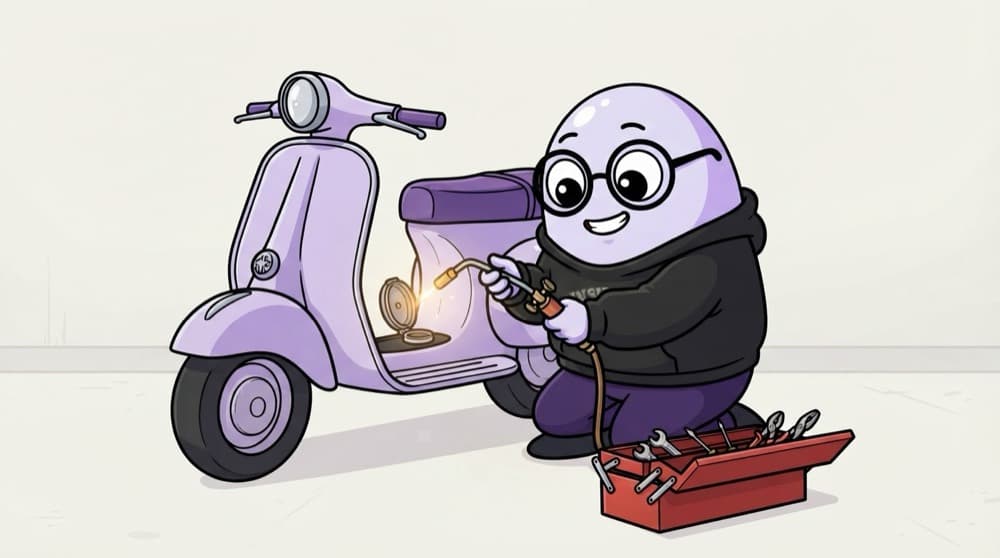
Think of it like this
The scooter mechanic
A good mechanic doesn't open the engine first when your scooter won't start. Fuel? Spark plug? Battery? Simple, likely causes get checked before the expensive ones. Debugging a model is the same: check the data and the pipeline before blaming the architecture.
Watch it happen
Where is it failing?
1/4First compare against a simple baseline. Then ask where the model fails: training, validation, or only in production.
The big ideas
What you need to know
Baseline first
A majority-class guess or simple linear model tells you if your fancy model is adding anything.
Check the data before the model
Wrong labels, duplicates across splits, missing values and leaked target columns cause most surprises.
Error analysis by slice
Group mistakes by city, device or class. A model is often fine overall and terrible on one slice.
Learning curves tell the story
Plot train and validation loss. A wide gap means overfitting; both high means underfitting.
See it in code
Walk through the code
1import pandas as pd2 3df = pd.read_csv("val_predictions.csv") # columns: city, device, label, pred4df["correct"] = df["label"] == df["pred"]5 6print("overall:", round(df["correct"].mean(), 3))7by_slice = (df.groupby(["city", "device"])["correct"]8 .agg(accuracy="mean", n="size")9 .sort_values("accuracy"))10print(by_slice.head(5)) # the worst slices are where to look first1/3Load saved validation predictions and mark each row right or wrong.
Slice-based error analysis in a few lines. It often reveals that "the model is bad" really means "the model is bad on old Android phones in one city".
Save yourself the pain
Common mistakes
Oops
Answering "I'd try a bigger model" or "I'd tune hyperparameters" first.
Do this instead
Start with data and pipeline checks, compare with a baseline, then look at where errors happen.
Oops
Trusting a suspiciously great validation score.
Do this instead
Look for leakage: a feature that's only known after the outcome, or the same user in train and test.
Your mission
Break a model, then debug it
Quick check
A model scores 99% on validation but 70% in production. Which cause should you suspect first?
Go deeper
- 1Build a mental checklist: data quality, label quality, feature leakage, overfitting, underfitting.
- 2Practice narrating your debugging process out loud, not just the final fix.
- 3Review a real bug you hit in a project and be ready to tell that story in an interview.
More technical at this stop
 ML Fundamentals & Math
 Deep Learning & Architectures
 LLM/GenAI Concepts
 System design (AI/ML)
 RAG & Vector Database Design
 Prompt Engineering Questions
 Model Evaluation & Trade-offs

Stuck on this topic? Ask an Insider
Get 1:1 guidance from people who've walked this exact path — on the InsideEdge app.
