Deep Learning & Architectures
Part of the AI Engineer Roadmap
In short
"Why did Transformers replace RNNs?" is a favourite question, and a great one to nail. Show you understand how CNNs, RNNs and attention each see data, and the rest of the round gets easier.
Expect questions on how CNNs, RNNs and Transformers work, why attention replaced recurrence, and practical debugging of training issues (vanishing gradients, overfitting).
Think of it like this
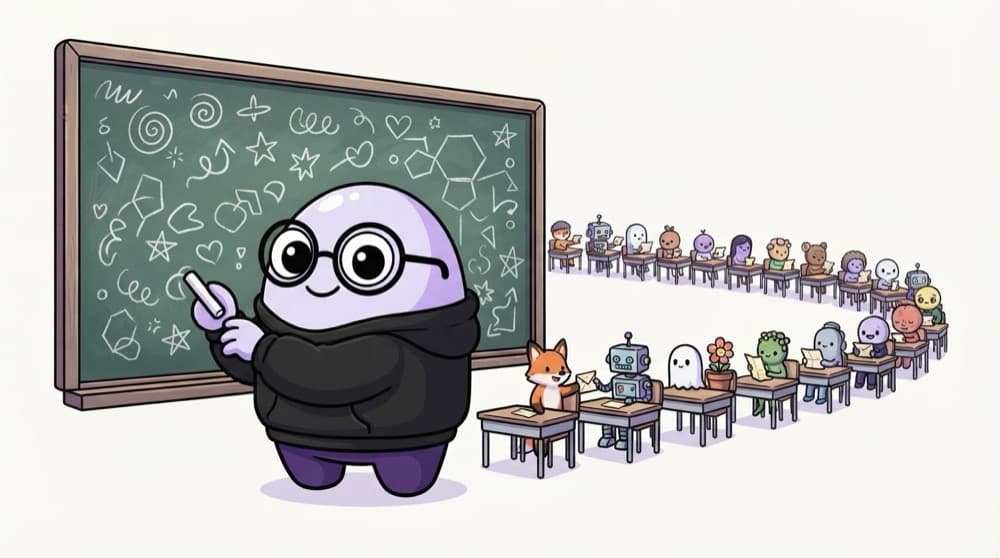
Passing notes vs the blackboard
In class, a message passed bench to bench gets slower and more garbled the further it travels. That's an RNN: one word at a time, memory fading. Write it on the blackboard and every student reads the whole thing at once and focuses on the parts they need. That's attention.
Watch it happen
RNN vs Transformer
RNN / LSTM
- Reads one token after another
- Hard to train on parallel hardware
- Early words fade over long text
Transformer
- Every token attends to every other
- Whole sequence trains in parallel
- Cost grows with length squared
Transformers won because they train in parallel and link distant words directly. The price is attention cost on very long inputs.
The big ideas
What you need to know
CNNs look locally
Small filters slide over an image, finding edges, then shapes, then objects. Weight sharing keeps parameters low.
RNNs carry a memory
Hidden state passes along each step. Gradients can vanish over long sequences; LSTM gates help.
Attention compares everything
Each token scores every other token, then takes a weighted mix. Position encodings add word order back in.
Training troubles to know
Vanishing or exploding gradients, overfitting, bad learning rates. Residual connections and normalisation help deep nets train.
See it in code
Walk through the code
1import numpy as np2 3def attention(Q, K, V):4 d_k = Q.shape[-1]5 scores = Q @ K.T / np.sqrt(d_k) # how much each token looks at each other6 scores -= scores.max(axis=-1, keepdims=True) # for numerical stability7 weights = np.exp(scores)8 weights /= weights.sum(axis=-1, keepdims=True) # softmax: each row sums to 19 return weights @ V10 11tokens = np.random.rand(4, 8) # 4 tokens, 8 numbers each12out = attention(tokens, tokens, tokens)13print(out.shape) # (4, 8)1/3Dot products score every token pair. Dividing by sqrt(d_k) stops scores getting so large the softmax saturates.
Scaled dot-product attention in ten lines. Being able to write this on a whiteboard, and explain why we divide by the square root of d_k, impresses interviewers.
Save yourself the pain
Common mistakes
Oops
Saying "Transformers are better" with no reason.
Do this instead
Give the two reasons: parallel training over the whole sequence, and direct links between distant tokens.
Oops
Forgetting the costs when praising attention.
Do this instead
Mention that attention cost grows with the square of sequence length, which is why long context is expensive.
Your mission
Architecture whiteboard drill
Quick check
What's the main reason Transformers train faster than RNNs on modern GPUs?
Go deeper
- 1Be able to explain backpropagation and attention from first principles, not just at a high level.
- 2Practice explaining why Transformers largely replaced RNNs for sequence tasks.
- 3Review common training failure modes and how you'd diagnose them.
More technical at this stop
 ML Fundamentals & Math
 LLM/GenAI Concepts
 System design (AI/ML)
 RAG & Vector Database Design
 Prompt Engineering Questions
 Model Evaluation & Trade-offs
 Debugging Model Performance Issues

Stuck on this topic? Ask an Insider
Get 1:1 guidance from people who've walked this exact path — on the InsideEdge app.
