RAG & Vector Database Design
Part of the AI Engineer Roadmap
In short
"How would you chunk these documents?" "Why is retrieval missing obvious answers?" "How does it scale to 10 million chunks?" RAG deep-dives are now common, and specific answers stand out.
A frequent deep-dive topic given how common RAG systems are in production — expect questions on chunking strategy, retrieval quality, and scaling a vector index.
Think of it like this
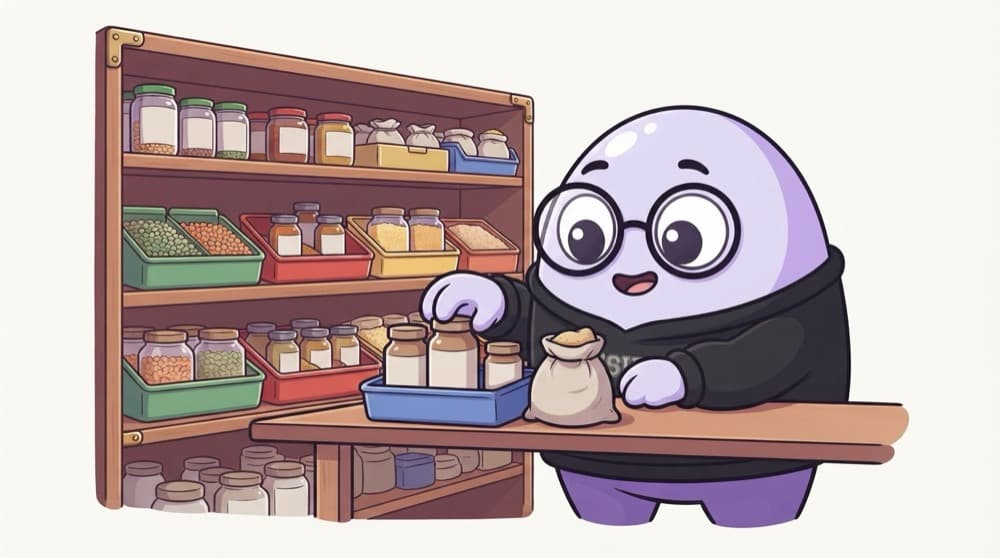
The well-organised kirana shelf
A good kirana uncle doesn't keep stock in one big heap. Similar things sit together: dals in one rack, spices in another. When you ask for moong dal, he goes straight to the right rack and picks from a few nearby packets. A vector index arranges chunks by meaning the same way.
Watch it happen
Design choices at each stage
1/6Extract text from PDFs and pages. Keep metadata like source, date and section for filtering and citations.
The big ideas
What you need to know
Chunking is a trade-off
Smaller chunks match precisely but lose context. Larger ones keep context but match loosely. Test a few sizes on real questions.
Hybrid search catches more
Vectors match meaning; keywords match exact terms like error codes and names. Together they miss less.
Metadata filters
Filtering by date, department or user permission keeps results relevant and stops people seeing documents they shouldn't.
Measure retrieval separately
Track recall@k: how often the right chunk is in the top k. Fix that before tuning prompts.
See it in code
Walk through the code
1CREATE EXTENSION IF NOT EXISTS vector;2 3CREATE TABLE chunks (4 id bigserial PRIMARY KEY,5 doc_id text NOT NULL,6 content text NOT NULL,7 embedding vector(384) -- must match your embedding model's size8);9 10CREATE INDEX ON chunks USING hnsw (embedding vector_cosine_ops);11-- Top 5 nearest chunks to the question vector ($1), filtered by document12SELECT id, content, embedding <=> $1 AS distance13FROM chunks14WHERE doc_id = 'hr-policy'15ORDER BY embedding <=> $116LIMIT 5;1/3Each chunk keeps its text, its source and its embedding. The vector size must match your model.
A vector store inside plain Postgres with the pgvector extension. Being able to sketch this shows you know a vector DB is a table plus an index, not magic.
Save yourself the pain
Common mistakes
Oops
Picking one chunk size and never testing others.
Do this instead
Build 30 test questions, try two or three chunk sizes, and compare recall@5 for each.
Oops
Relying on vector search alone for product codes, names and exact phrases.
Do this instead
Add keyword search like BM25 alongside vectors. Embeddings often blur exact identifiers.
Your mission
Chunk size experiment
Quick check
Users search for error code "E-4021" and your RAG system keeps returning loosely related chunks. What's the best fix?
Go deeper
- 1Be ready to walk through your own RAG project's design decisions in detail.
- 2Practice explaining chunking, hybrid search and reranking trade-offs clearly.
- 3Prepare an answer for 'how would you evaluate whether your RAG system is actually good.'
More technical at this stop
 ML Fundamentals & Math
 Deep Learning & Architectures
 LLM/GenAI Concepts
 System design (AI/ML)
 Prompt Engineering Questions
 Model Evaluation & Trade-offs
 Debugging Model Performance Issues

Stuck on this topic? Ask an Insider
Get 1:1 guidance from people who've walked this exact path — on the InsideEdge app.
