
In short
You never free memory yourself in JavaScript. A garbage collector quietly clears out values nobody can reach any more. Knowing what "reachable" means helps you avoid leaks.
JavaScript's automatic process of freeing memory no longer reachable by any reference, so you don't have to manually deallocate memory like in C. Garbage collection is based on reachability rather than whether a variable 'looks unused', so lingering references can keep large object graphs alive.
Think of it like this
The warden's semester-end check
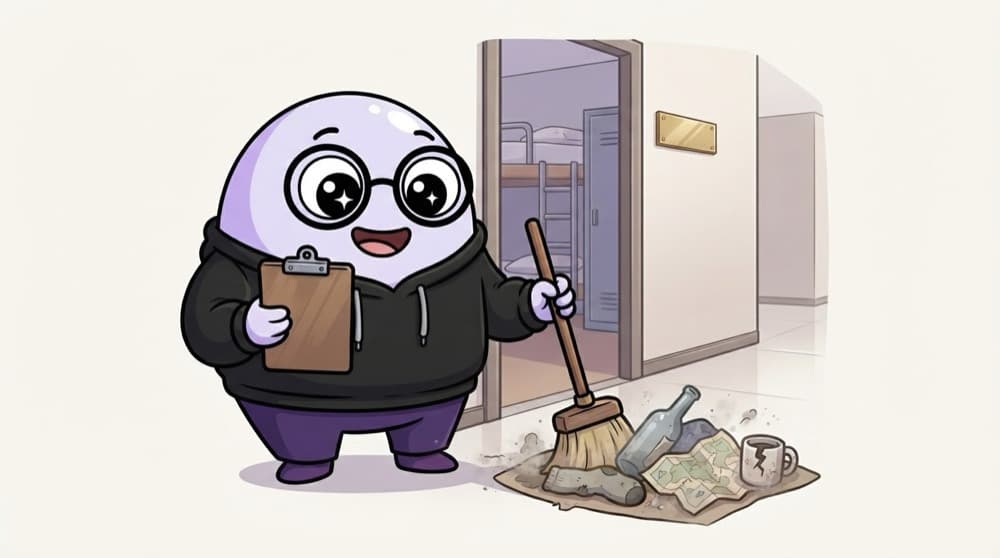
At semester end, the warden checks every room. Anything a current student can claim stays. Stuff nobody can trace back to anyone gets cleared out. The garbage collector does the same: if no variable can reach a value, it gets removed.
Watch it happen
Is { name: Arjun } still reachable?
1/4Both variables point at the object. It's reachable from the roots, so it stays.
The big ideas
What you need to know
Reachability is the rule
Start from roots like global variables and the current call stack. Anything you can reach from them stays alive.
Mark and sweep
The collector marks everything reachable, then sweeps away the rest and reuses that memory.
Cycles are fine
Two objects pointing at each other still get collected if nothing else reaches them.
You don't control the timing
The engine decides when to collect. Setting a variable to null only makes the value eligible, it doesn't free it right away.
How it works
A mark-and-sweep round
- 1
Start at the roots
Globals and variables on the current call stack.
- 2
Mark
Follow every reference from the roots and mark each object reached.
- 3
Sweep
Any object left unmarked can't be used by your code, so it's removed.
- 4
Reuse
The freed memory is available for new objects.
See it in code
Walk through the code
1let student = { name: "Arjun" };2let topper = student; // two references to the same object3 4student = null; // still reachable through topper5topper = null; // now unreachable, it can be collected6 7function makePair() {8 const a = {};9 const b = {};10 a.friend = b;11 b.friend = a; // a cycle12 return "done";13}14makePair(); // both become unreachable after this, cycle or not1/4Two variables, one object.
An object is kept as long as at least one path from a root leads to it. Cut every path and it becomes garbage.
Save yourself the pain
Common mistakes
Oops
Thinking obj = null instantly frees the memory.
Do this instead
It only removes one reference. The object is freed later, and only if nothing else still points to it.
Oops
Worrying that circular references leak in JavaScript.
Do this instead
Mark and sweep handles cycles. The real leaks come from references you forgot about, like a global cache.
Your mission
Reachable or not?
Quick check
let a = {}; let b = a; a = null; Can the object be garbage collected now?
Go deeper
- 1Read about the 'mark-and-sweep' algorithm most engines use. Then apply the idea in a small example so the theory becomes practical.
- 2Understand what 'reachability' means in the context of garbage collection. Be able to explain the concept in your own words and identify where it appears in a real application.
- 3Learn common patterns (forgotten timers, global references) that prevent objects from being collected.
More topics at this stop
 Variables
 Datatypes
 Operators
 Functions
 Scope
 Hoisting
 Closures
 this keyword
 Objects
 Arrays
 Methods
 Loops
 DOM
 Events
 Promises
 Callbacks
 Async Await
 Modules
 Classes
 Prototype
 OOP
 Error Handling
 Debouncing
 Throttling
 Event Delegation
 Execution Context
 Call Stack
 Memory
 ES6+
 Map
 Set
 WeakMap
 WeakSet
 Generators
 Iterators

Stuck on this topic? Ask an Insider
Get 1:1 guidance from people who've walked this exact path — on the InsideEdge app.
