In short
Object-oriented programming is a way of organising code around things that hold data and know how to act on it. It shows up in interviews and in most large codebases.
Object-Oriented Programming — structuring code around objects with encapsulated state and behavior, using classes, inheritance and polymorphism. OOP is one way to organize software around state and behavior, and its usefulness depends on whether objects and relationships actually fit the problem being solved.
Think of it like this
The auto-rickshaw
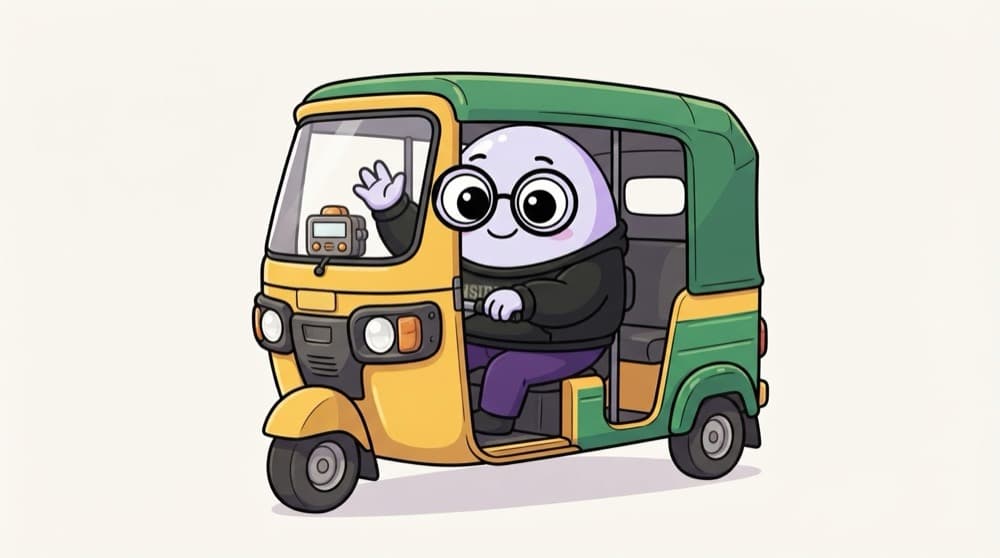
Every auto has a meter, fuel and a driver (data) and it can start, stop and calculate a fare (behaviour). You never open the engine to ride one. You just say "chalo". Hiding the messy insides behind simple actions is the heart of OOP.
Watch it happen
One loop, many fare() methods
ride.fare()
1/6The loop asks the first ride for its fare. It doesn't check the type.
The big ideas
What you need to know
Encapsulation
Keep data and the methods that change it together, and hide the internals. In JavaScript, #private fields help.
Inheritance
A child class reuses a parent's code with extends. Useful, but long inheritance chains get hard to change.
Polymorphism
Different classes share a method name, like fare(), and each does its own version. The caller doesn't care which one it got.
Composition often wins
Building objects out of smaller parts ("has a") is usually easier to change than deep "is a" family trees.
See it in code
Walk through the code
1class Vehicle {2 constructor(km) { this.km = km; }3 fare() { return 0; }4}5class Auto extends Vehicle {6 fare() { return 30 + this.km * 15; }7}8class Cab extends Vehicle {9 fare() { return 50 + this.km * 20; }10}11 12const rides = [new Auto(4), new Cab(4)];13for (const ride of rides) {14 console.log(ride.constructor.name, ride.fare());15}16// Auto 90 Cab 1301/3Vehicle stores km and has a default fare.
The loop calls fare() without checking the type. Each class answers in its own way. That's polymorphism, and adding a Bike class later needs no change to the loop.
Save yourself the pain
Common mistakes
Oops
Building five levels of inheritance: Vehicle, Motor, Car, Sedan, CitySedan.
Do this instead
Keep inheritance shallow. Pass in smaller parts, like a fare calculator, instead of inheriting everything.
Oops
Turning every small helper into a class.
Do this instead
JavaScript is happy with plain functions and objects. Use a class when you have many objects sharing data and behaviour.
Your mission
Fare app in OOP
Quick check
Auto and Cab each have their own fare() method, and the loop calls ride.fare() without checking the type. Which OOP idea is this?
Go deeper
- 1Model a small real-world domain (e.g. a library) with classes and relationships. Validate your understanding by applying it in a small practical example.
- 2Practice encapsulation using private class fields (`#field`). Test it with at least one normal case and one edge case so you can explain the behavior confidently.
- 3Compare an OOP solution to the same problem solved functionally.
More topics at this stop
 Variables
 Datatypes
 Operators
 Functions
 Scope
 Hoisting
 Closures
 this keyword
 Objects
 Arrays
 Methods
 Loops
 DOM
 Events
 Promises
 Callbacks
 Async Await
 Modules
 Classes
 Prototype
 Error Handling
 Debouncing
 Throttling
 Event Delegation
 Execution Context
 Call Stack
 Memory
 Garbage Collection
 ES6+
 Map
 Set
 WeakMap
 WeakSet
 Generators
 Iterators

Stuck on this topic? Ask an Insider
Get 1:1 guidance from people who've walked this exact path — on the InsideEdge app.
