In short
A neural network is functions inside functions inside functions. The chain rule is how you find the effect of a weight deep inside on the final error. It's the maths behind backpropagation.
The calculus rule for differentiating composed functions — the exact mathematical mechanism behind backpropagation in neural networks.
Think of it like this
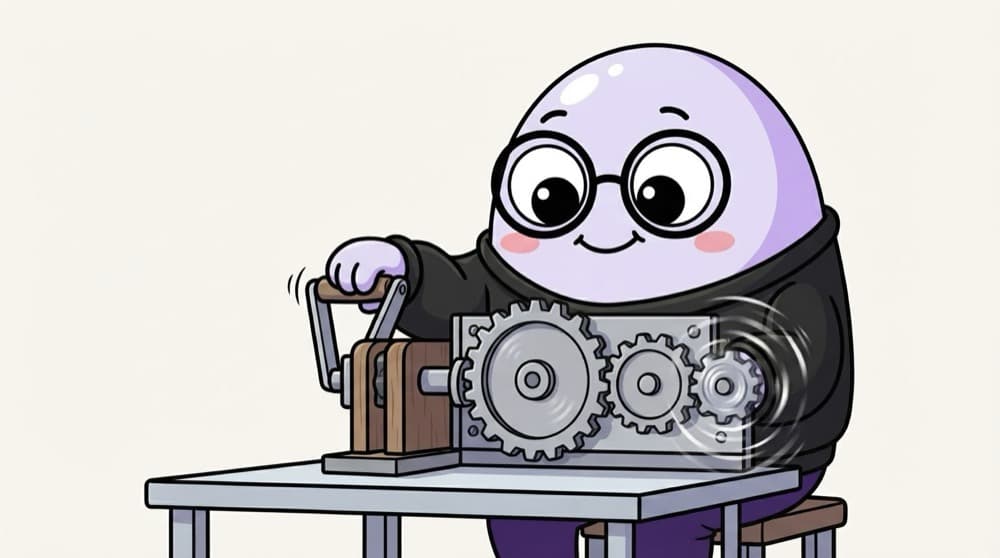
Gears in a row
Turn a big gear once and the middle gear turns 3 times. The middle one turns the small gear 2 times for each of its turns. So the small gear spins 3 × 2 = 6 times. The chain rule works the same way: multiply the rates along the chain.
Watch it happen
y = (3x + 1)² at x = 2
1/4Forward pass starts with the input x = 2.
The big ideas
What you need to know
Multiply along the chain
If y depends on u and u depends on x, then dy/dx = dy/du × du/dx.
Each layer is one link
In a network, each layer only needs its own local derivative. The chain rule stitches them together.
Backprop runs it backwards
Start at the loss and multiply local derivatives layer by layer towards the input. That reuses work and is fast.
Frameworks do it for you
PyTorch records every operation and applies the chain rule when you call .backward().
See it in code
Walk through the code
1# by hand2x = 2.03u = 3 * x + 1 # inner: u = 74y = u ** 2 # outer: y = 495dy_du = 2 * u # 146du_dx = 37print(dy_du * du_dx) # 42.08 9# the same with PyTorch autograd10import torch11xt = torch.tensor(2.0, requires_grad=True)12yt = (3 * xt + 1) ** 213yt.backward()14print(xt.grad) # tensor(42.)1/4Forward pass: compute the inner value, then the outer value.
Both give 42. PyTorch builds the chain of operations as you compute, then backward() multiplies the local derivatives for you.
Save yourself the pain
Common mistakes
Oops
Adding the local derivatives instead of multiplying them.
Do this instead
Along one chain you multiply. You add only when a variable affects the output through two separate paths.
Oops
Forgetting that the outer derivative uses the inner value, like writing 2x instead of 2u.
Do this instead
Evaluate each local derivative at the value that flowed into it during the forward pass.
Your mission
Backprop by hand
Quick check
u = 5x and y = u². At x = 1, what is dy/dx?
Go deeper
- 1Practice the chain rule on nested functions by hand.
- 2Trace a tiny 2-layer neural network's backward pass and identify each chain-rule step.
- 3Understand why backpropagation is 'just' repeated application of the chain rule.
More topics at this stop
 Linear Algebra Basics (Vectors, Matrices)
 Matrix Operations
 Eigenvalues & Eigenvectors
 Calculus Basics (Derivatives, Gradients)
 Partial Derivatives
 Probability Fundamentals
 Probability Distributions
 Bayes' Theorem
 Descriptive Statistics
 Hypothesis Testing
 Correlation vs Causation
 Optimization Basics (Gradient Descent)

Stuck on this topic? Ask an Insider
Get 1:1 guidance from people who've walked this exact path — on the InsideEdge app.
