
Probability Fundamentals
Part of the AI Engineer Roadmap
In short
A classifier saying '92% spam' is speaking probability. Before you can trust, tune or explain model outputs, you need the basic rules of chance.
Random variables, events, and basic probability rules — the language models use to express uncertainty in predictions.
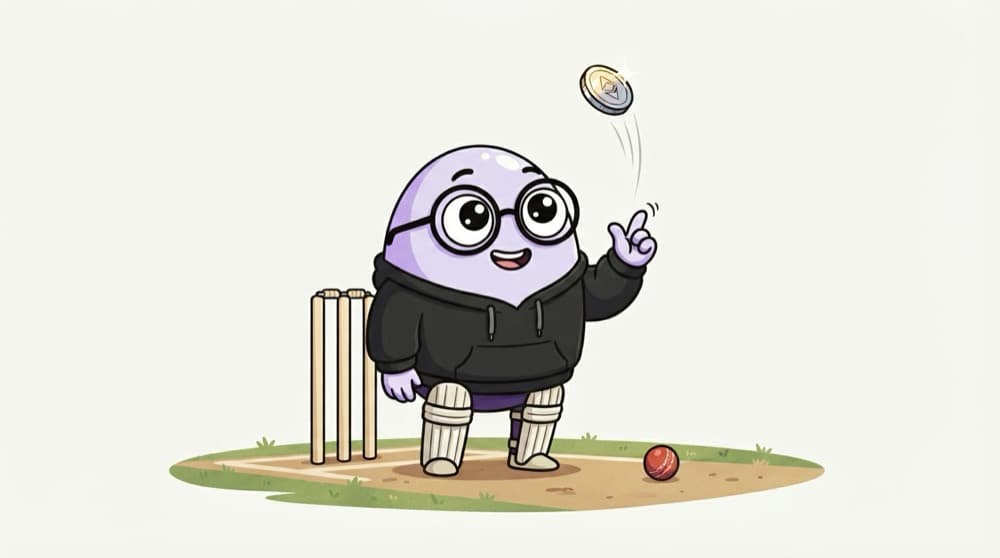
Think of it like this
The toss before a match
Before every cricket match, a coin decides who bats first. Nobody knows the next toss, but over a whole season, heads comes up about half the time. Probability is that long-run share. One toss is unpredictable, thousands of tosses are not.
Watch it happen
Ten tosses, counting heads
1/4After 1 toss: 1 head. Share of heads = 1/1 = 1.0. Way off 0.5, but it's only one toss.
The big ideas
What you need to know
Between 0 and 1
P = 0 means impossible, P = 1 means certain. All outcomes of one event add up to 1.
Complement rule
P(not A) = 1 − P(A). If rain has a 0.3 chance, no rain has 0.7.
Or means add (if they can't overlap)
Rolling a 1 or a 2: 1/6 + 1/6 = 1/3. If events can overlap, subtract the overlap once.
And means multiply (if independent)
Two sixes in a row: 1/6 × 1/6 = 1/36. Only valid when one result doesn't affect the other.
See it in code
Walk through the code
1import random2random.seed(42)3 4rolls = [random.randint(1, 6) for _ in range(60_000)]5print(rolls.count(6) / len(rolls)) # close to 1/6, about 0.1676 7even = sum(r % 2 == 0 for r in rolls) / len(rolls)8print(even) # close to 0.59 10pairs = [(random.randint(1, 6), random.randint(1, 6)) for _ in range(36_000)]11both_six = sum(a == 6 and b == 6 for a, b in pairs) / len(pairs)12print(both_six, 1 / 36) # both near 0.0281/4Fixing the seed makes the random numbers repeat each run, so results are reproducible.
Simulation is a great way to check a probability rule. If your formula and the simulation disagree, one of them is wrong.
Save yourself the pain
Common mistakes
Oops
Thinking after five heads in a row, tails is 'due'.
Do this instead
Each fair toss is independent. The coin has no memory, so the next toss is still 50-50.
Oops
Multiplying probabilities of events that affect each other.
Do this instead
Only multiply directly when events are independent. Otherwise use conditional probability: P(A and B) = P(A) × P(B given A).
Your mission
Check the rules by simulation
Quick check
A model says P(spam) = 0.85 for an email. What is P(not spam)?
Go deeper
- 1Review basic probability rules: complement, union, intersection, conditional probability.
- 2Practice computing probabilities on simple discrete examples (dice, cards).
- 3Learn independence vs. conditional dependence between events.
More topics at this stop
 Linear Algebra Basics (Vectors, Matrices)
 Matrix Operations
 Eigenvalues & Eigenvectors
 Calculus Basics (Derivatives, Gradients)
 Chain Rule
 Partial Derivatives
 Probability Distributions
 Bayes' Theorem
 Descriptive Statistics
 Hypothesis Testing
 Correlation vs Causation
 Optimization Basics (Gradient Descent)

Stuck on this topic? Ask an Insider
Get 1:1 guidance from people who've walked this exact path — on the InsideEdge app.
