
In short
"Something went wrong" helps nobody. A custom exception like OrderNotFoundException tells the reader exactly what failed, and lets callers catch just that case.
You can create your own exception classes by extending Exception (checked) or RuntimeException (unchecked) to describe errors specific to your application.
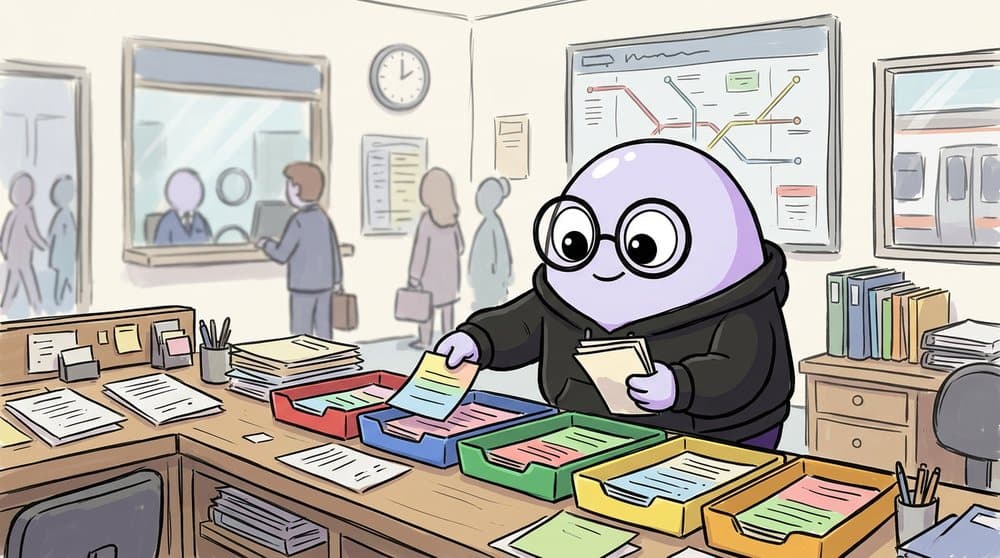
Think of it like this
Labelled complaint forms
A railway office in Chennai has one generic complaint box, and every letter must be read to know what it is about. Then they print special forms: Lost Luggage, Refund Delay, Seat Problem. Each lands on the right desk straight away. Custom exceptions are those labelled forms.
Watch it happen
Two ways to build your own exception
extends Exception (checked)
- Caller must catch or declare it
- For problems a careful caller can still hit
- Example: OrderNotFoundException
extends RuntimeException (unchecked)
- No forced handling
- For invalid input or broken rules from the caller
- Example: InvalidPincodeException
Pick the parent based on who is at fault. Most modern frameworks lean on unchecked exceptions, but checked ones are still useful for recoverable situations.
The big ideas
What you need to know
Name ends with Exception
Use clear names like PaymentDeclinedException. The name alone should explain the problem.
Pass a message up
Call super(message) in the constructor so getMessage() shows a helpful description.
Keep the cause
Add a constructor that takes Throwable cause and call super(message, cause). The original stack trace is kept for debugging.
Carry extra data
A custom exception is a normal class. Add fields like orderId so the catch block can use them.
See it in code
Walk through the code
1// Checked: callers must plan for a missing order2public class OrderNotFoundException extends Exception {3 private final String orderId;4 5 public OrderNotFoundException(String orderId) {6 super("No order found with id " + orderId);7 this.orderId = orderId;8 }9 10 public OrderNotFoundException(String orderId, Throwable cause) {11 super("No order found with id " + orderId, cause);12 this.orderId = orderId;13 }14 15 public String getOrderId() {16 return orderId;17 }18}19 20// Unchecked: a bad pincode is the caller's mistake, so fail fast21class InvalidPincodeException extends RuntimeException {22 public InvalidPincodeException(String pincode) {23 super("Pincode must be 6 digits, got: " + pincode);24 }25}26 27class DeliveryCheck {28 static void checkPincode(String pin) {29 if (pin == null || !pin.matches("[0-9]{6}")) {30 throw new InvalidPincodeException(pin);31 }32 }33}1/4Extending Exception makes it checked. The orderId field travels with the error.
Two custom exceptions for a food delivery app. OrderNotFoundException carries the order id; InvalidPincodeException fails fast on bad input.
Save yourself the pain
Common mistakes
Oops
Catching a low-level exception and throwing a new custom one without the cause.
Do this instead
throw new OrderNotFoundException(id, e); Passing e keeps the original stack trace, which you will need when debugging.
Oops
Creating a custom exception for every tiny case: NameTooShortException, NameTooLongException ...
Do this instead
Use built-ins like IllegalArgumentException when they fit. Create custom types when callers need to handle the case differently.
Oops
Extending Throwable or Error directly.
Do this instead
Extend Exception or RuntimeException. Error is reserved for serious JVM problems.
Your mission
Exceptions for a cinema app
Quick check
You want callers to be forced by the compiler to handle your new exception. What should it extend?
Go deeper
- 1Create InsufficientFundsException for your bank project.
- 2Pass a clear message and the original cause to the super constructor.
- 3Decide whether your exception should be checked or unchecked, and why.
More topics at this stop
 Checked vs Unchecked Exceptions
 Try-Catch-Finally
 Try-with-Resources
 throw vs throws
 Reading & Writing Files (java.nio.file)
 Working with CSV Files
 Serialization Basics

Stuck on this topic? Ask an Insider
Get 1:1 guidance from people who've walked this exact path — on the InsideEdge app.
