
In short
RLHF works, but training a reward model and running PPO is fiddly. DPO uses the same 'this answer is better than that one' data and trains the model directly. Simpler, cheaper and now very common.
Direct Preference Optimization — a simpler alternative to RLHF that directly optimizes on preference pairs without training a separate reward model.
Think of it like this
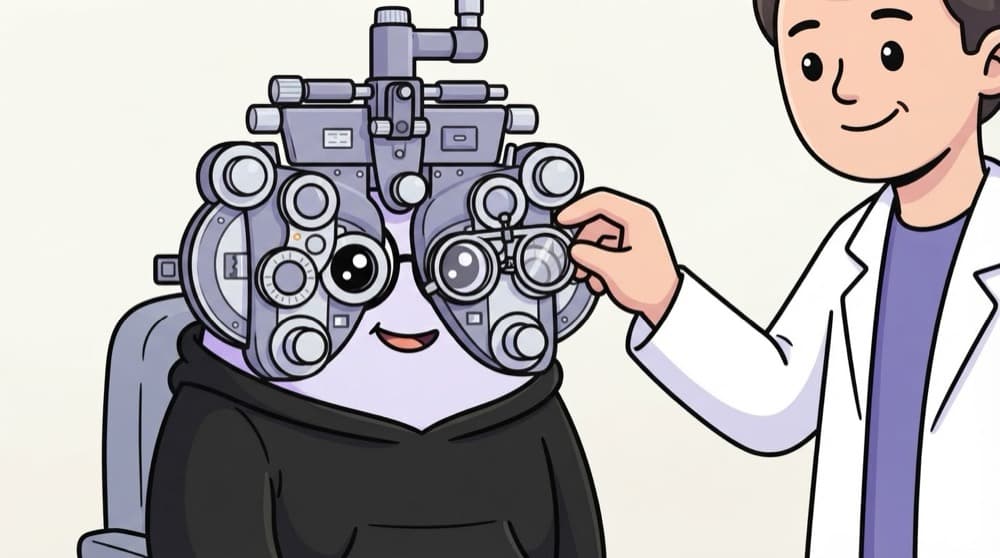
The eye test
At the eye clinic, the optometrist flips lenses: 'Better with one, or two?' You just say which is clearer. No scoring out of 10, no separate judge. After a few rounds, your prescription is set. DPO learns from pairs exactly like that: preferred vs not preferred.
Watch it happen
RLHF vs DPO
RLHF (PPO)
- Trains a separate reward model
- Then runs reinforcement learning
- Powerful but tricky to tune
DPO
- No reward model needed
- A simple loss on preference pairs
- Trains like normal fine-tuning
For most teams with preference data, DPO is the practical first choice. RLHF with PPO is used when you need the extra control and have the expertise.
The big ideas
What you need to know
Data: chosen vs rejected
Each row has a prompt, a chosen answer and a rejected answer. The model learns to prefer the chosen one.
Reference model
A frozen copy of the starting model keeps training anchored, playing the same role as the KL penalty in RLHF.
Beta controls strength
The beta setting decides how far the model may move from the reference. Small values stay closer.
Works with LoRA
DPO combines well with LoRA or QLoRA, so it can run on modest GPUs.
See it in code
Walk through the code
1{"prompt": "Explain what a credit score is to a college student.",2 "chosen": "A credit score is a number showing how reliably you repay loans. Paying credit card bills on time raises it.",3 "rejected": "Credit scores are complicated financial metrics computed by bureaus using proprietary algorithms."}1/3The prompt both answers respond to.
One line of a DPO dataset in JSONL. Libraries like Hugging Face TRL's DPOTrainer read this shape.
Save yourself the pain
Common mistakes
Oops
Making 'rejected' answers obviously terrible.
Do this instead
Pairs that are close in quality teach finer preferences. Very easy pairs teach little.
Oops
Running DPO on a base model with no instruction tuning.
Do this instead
Do SFT first so the model already follows instructions, then DPO to refine preferences.
Your mission
Make a preference set
Quick check
What does DPO remove compared to classic RLHF?
Go deeper
- 1Read how DPO reformulates the RLHF objective into a single supervised loss.
- 2Compare the practical complexity of setting up DPO vs. full RLHF.
- 3Try a DPO fine-tuning example on a small open-weight model if hardware allows.
More topics at this stop
 Full Fine-Tuning vs PEFT
 LoRA & QLoRA
 Instruction Tuning
 RLHF (Overview)
 Dataset Preparation for Fine-Tuning
 Model Quantization
 Model Distillation
 Evaluating Fine-Tuned Models

Stuck on this topic? Ask an Insider
Get 1:1 guidance from people who've walked this exact path — on the InsideEdge app.
