In short
Big models are smart but slow and costly. Distillation trains a small 'student' model to imitate a big 'teacher', so you keep much of the skill at a fraction of the cost.
Training a smaller 'student' model to mimic a larger 'teacher' model's outputs — a way to get much of a large model's quality at a fraction of the inference cost.
Think of it like this
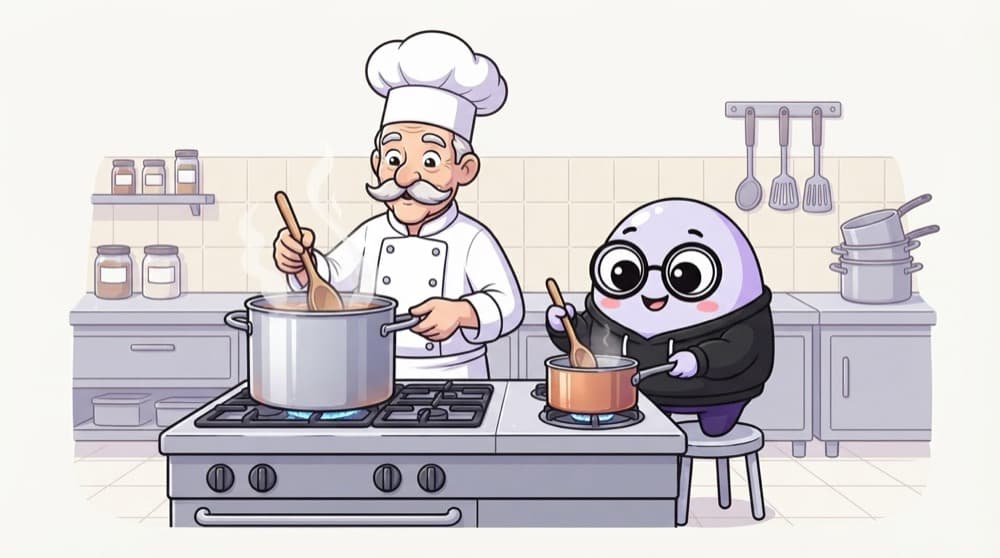
Learning from the head chef
A new cook doesn't read every cookbook in the world. He stands next to the head chef and copies how he tastes, stirs and adjusts. He'll never know everything the chef knows, but for the restaurant's menu he becomes nearly as good, and much cheaper.
Watch it happen
One round of distillation
'Classify: late order'
1/5A batch of task inputs goes to the large teacher model.
The big ideas
What you need to know
Teacher and student
The teacher is large and accurate. The student is small and fast. The student learns from the teacher's outputs.
Soft labels carry hints
'85 percent ORDER, 10 percent REFUND' tells the student more than just 'ORDER'. A temperature setting softens these further.
LLM-style distillation
For LLMs, a common shortcut is generating teacher answers and fine-tuning the student on them as text.
Check the licence
Some providers' terms restrict using their outputs to train competing models. Read the terms first.
See it in code
Walk through the code
1import torch.nn.functional as F2 3def distill_loss(student_logits, teacher_logits, labels, T=2.0, alpha=0.5):4 soft = F.kl_div(5 F.log_softmax(student_logits / T, dim=-1),6 F.softmax(teacher_logits / T, dim=-1),7 reduction="batchmean",8 ) * (T * T)9 hard = F.cross_entropy(student_logits, labels)10 return alpha * soft + (1 - alpha) * hard1/3T softens both distributions. alpha balances teacher-matching and true-label learning.
The classic distillation loss: match the teacher's softened probabilities, plus normal loss on true labels.
Save yourself the pain
Common mistakes
Oops
Expecting a tiny student to match the teacher on every task.
Do this instead
Distil for a specific task. Narrow students can get close; general ones lose more.
Oops
Generating teacher data with an API without reading its terms.
Do this instead
Check usage policies before training on any provider's outputs.
Your mission
Distil a classifier
Quick check
Why do students often learn better from the teacher's soft probabilities than from hard labels alone?
Go deeper
- 1Read a case study of a distilled model (e.g. DistilBERT) vs. its teacher.
- 2Learn the basic distillation training setup: matching soft labels/logits from the teacher.
- 3Understand when distillation is worth the extra training pipeline complexity.
More topics at this stop
 Full Fine-Tuning vs PEFT
 LoRA & QLoRA
 Instruction Tuning
 RLHF (Overview)
 DPO (Overview)
 Dataset Preparation for Fine-Tuning
 Model Quantization
 Evaluating Fine-Tuned Models

Stuck on this topic? Ask an Insider
Get 1:1 guidance from people who've walked this exact path — on the InsideEdge app.
