
In short
A raw pretrained model will happily continue your question with three more questions. Instruction tuning teaches it to actually answer. It's the step that turned text predictors into helpful assistants.
Fine-tuning a pretrained model on (instruction, response) pairs so it learns to follow directions rather than just complete text — the step that turns a base model into an assistant.
Think of it like this
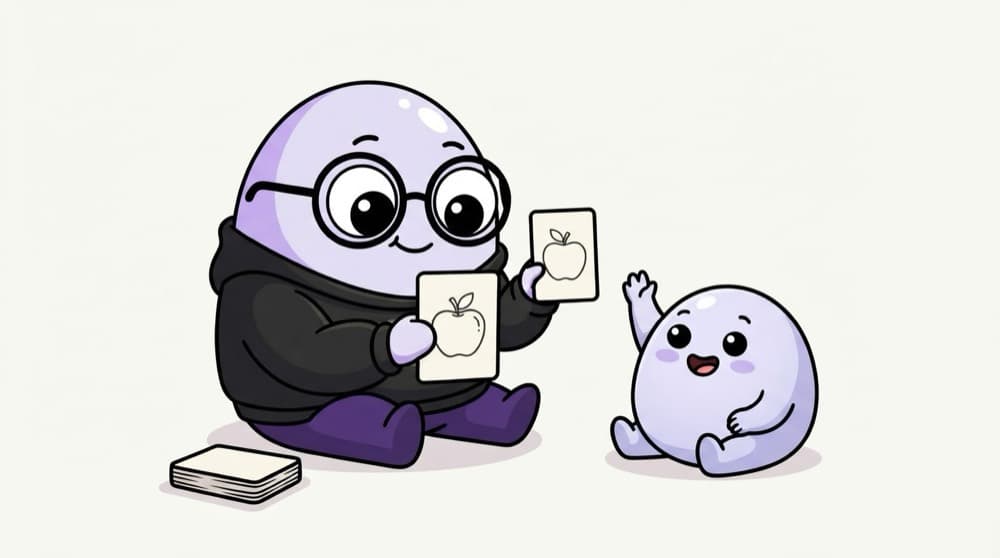
The flash card tutor
A bright kid knows lots of words but doesn't know how to answer exam questions. A tutor drills flash cards: question on one side, model answer on the other. After hundreds of cards, the kid answers in the right style every time. That's instruction tuning.
Watch it happen
Where the model learns in one training example
1/5One training example, laid out with the model's chat template.
The big ideas
What you need to know
Instruction and response pairs
Data looks like (instruction, optional input, ideal response). Variety across tasks matters as much as quantity.
Use the chat template
Each model family has special tokens for roles. Format data with tokenizer.apply_chat_template, or results suffer.
Train on answers only
Masking the prompt from the loss focuses learning on responses. Many trainers support this directly.
Quality over volume
A few thousand clean, diverse examples can beat a huge noisy set. Bad answers teach bad habits.
See it in code
Walk through the code
1from transformers import AutoTokenizer2 3tok = AutoTokenizer.from_pretrained("<open-instruct-model>")4 5example = [6 {"role": "user", "content": "Translate 'thank you' to Hindi."},7 {"role": "assistant", "content": "Dhanyavaad (धन्यवाद)."},8]9text = tok.apply_chat_template(example, tokenize=False)10print(text) # shows the special role tokens this model expects1/3Load the tokenizer of the model you'll fine-tune. It contains the chat template.
Let the tokenizer format your data. Every model family uses different special tokens for roles.
Save yourself the pain
Common mistakes
Oops
Writing your own '### User:' format for a model that has its own chat template.
Do this instead
Use the model's template. Mismatched formats confuse the model and waste training.
Oops
Training on 10,000 near-identical examples.
Do this instead
Diversity matters. Vary topics, lengths and phrasing, and remove duplicates.
Your mission
Build 30 instruction pairs
Quick check
Why do many instruction-tuning setups compute loss only on the assistant's tokens?
Go deeper
- 1Study the format of an instruction-tuning dataset (e.g. Alpaca-style).
- 2Fine-tune a small model on an instruction dataset and compare its behavior before/after.
- 3Learn how instruction tuning differs from RLHF as a later alignment step.
More topics at this stop
 Full Fine-Tuning vs PEFT
 LoRA & QLoRA
 RLHF (Overview)
 DPO (Overview)
 Dataset Preparation for Fine-Tuning
 Model Quantization
 Model Distillation
 Evaluating Fine-Tuned Models

Stuck on this topic? Ask an Insider
Get 1:1 guidance from people who've walked this exact path — on the InsideEdge app.
