Full Fine-Tuning vs PEFT
Part of the AI Engineer Roadmap
In short
Updating every weight of a 7B model needs big GPUs. PEFT trains a tiny add-on instead and often gets close. Knowing the difference decides whether you can fine-tune on a free Colab or not.
Full fine-tuning updates every model weight (expensive, needs lots of GPU memory); Parameter-Efficient Fine-Tuning updates a small subset — PEFT is the practical default outside large labs.
Think of it like this
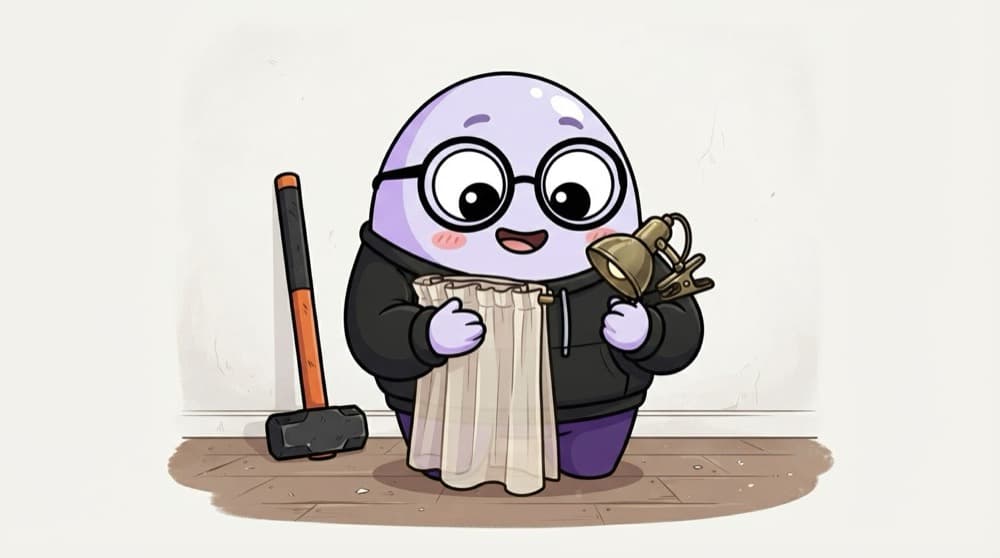
Renovating vs redecorating a rented flat
You can knock down walls and rebuild the kitchen: expensive, slow, and you can't easily undo it. Or you hang new curtains, add lamps and a rug: cheap, quick, and removable. Full fine-tuning is the renovation. PEFT is the redecoration.
Watch it happen
Train everything vs train a little
Full fine-tuning
- Updates all weights
- Needs lots of GPU memory
- Saves a full model copy
PEFT (e.g. LoRA)
- Freezes base, trains small add-ons
- Fits on one modest GPU
- Adapter file is often a few MB
Start with PEFT. Move to full fine-tuning only when you have lots of data, big GPUs, and PEFT has clearly hit a ceiling.
The big ideas
What you need to know
Memory is the bottleneck
Full fine-tuning stores gradients and optimiser states for every weight, often several times the model's own size.
PEFT family
LoRA, QLoRA, adapters and prompt tuning all train a small number of new parameters while the base stays frozen.
Swap adapters
One base model can serve many tasks by loading different small adapters, like one per customer.
Less forgetting
Since the base weights don't change, PEFT tends to forget less of the model's general skills.
See it in code
Walk through the code
1from transformers import AutoModelForCausalLM2from peft import LoraConfig, get_peft_model3 4model = AutoModelForCausalLM.from_pretrained("<small-open-model>")5 6config = LoraConfig(r=16, lora_alpha=32, lora_dropout=0.05,7 target_modules=["q_proj", "v_proj"], task_type="CAUSAL_LM")8model = get_peft_model(model, config)9 10model.print_trainable_parameters()11# prints trainable params vs total params: usually well under 1%1/3Load any small open causal language model from the Hub.
Wrapping a model with LoRA via Hugging Face PEFT. Module names like q_proj vary by model family.
Save yourself the pain
Common mistakes
Oops
Assuming full fine-tuning is always better.
Do this instead
With small datasets, PEFT often matches it and overfits less. Compare both on a held-out test set if you can.
Oops
Copying target_modules from a tutorial for a different model.
Do this instead
Print model.named_modules() and pick the right layer names for your model's architecture.
Your mission
Count the parameters
Quick check
Why does PEFT need far less GPU memory than full fine-tuning?
Go deeper
- 1Compare the GPU memory and cost requirements of full fine-tuning vs. PEFT for a given model size.
- 2Learn why PEFT can match full fine-tuning quality on most task-specific use cases.
- 3Identify which approach makes sense for your hardware budget before starting a project.
More topics at this stop
 LoRA & QLoRA
 Instruction Tuning
 RLHF (Overview)
 DPO (Overview)
 Dataset Preparation for Fine-Tuning
 Model Quantization
 Model Distillation
 Evaluating Fine-Tuned Models

Stuck on this topic? Ask an Insider
Get 1:1 guidance from people who've walked this exact path — on the InsideEdge app.
